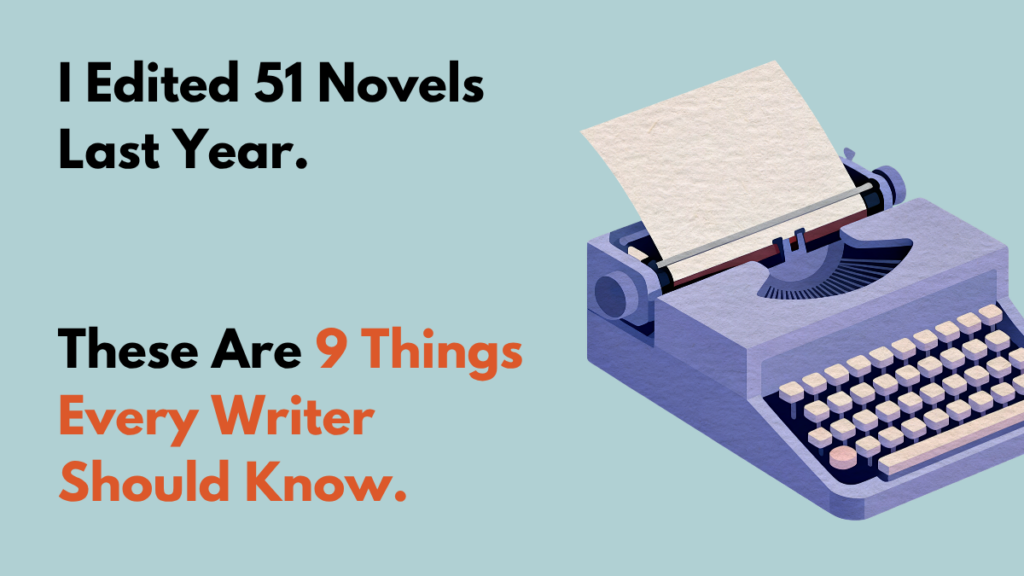
So last year I edited 51 novels. Yes, I was a busy guy. But after going through that experience, I came away with these 9 insights that I think every writer should know. These are insights which will help your writing career, they’ll help you write your novel, and they’ll just help you feel happier about yourself as a writer. Ultimately, by reading this, you’ll be set up to write a better novel.
1. What Writers Think Is Wrong With Their Book Is Often Not What’s Wrong With Their Book
When writers come to me and they say, “Oh, I really want you to pay attention to X, Y, Z,” I usually know that those parts aren’t gonna be a problem. The writer was so concentrated on those things that they gave a lot of attention to it, and they ended up doing it very, very well in their book.
Usually, the biggest problems in their book were things that weren’t even on their radar, and I have to be like, “This needs revision.” On the other hand, I at least got to tell them, like, “Hey, that stuff you were really worried about? You were fantastic with that.”
2. Writers Often Underestimate Their Skills
I always spend the beginning of each feedback essay talking about what the author did well. And usually, the first thing they write back to me is, “Oh, thank you so much for that praise. That was so reassuring.” And I’m like, “I was just being honest.” And they’re always so surprised, as if they weren’t aware of their own awesomeness.
But look, as a writer, you need to be just as knowledgeable about your strengths as you are about your weaknesses. And let’s be honest, writing can be a soul-crushing business, so of course when writers come to me, I want to tell them all the things that they’re doing really, really well, all the things that they’re talented in, all the things that their book is succeeding in.
3. Writers Underestimate the Amount of Revision Required
Look, I know this can be a huge downer, and I don’t mean to be a Sad Sally all over you. But by the time you get your work to an editor, you might only be halfway or two-thirds through the process of writing your novel.
I know, I know, you wanna reach through the camera and punch me right now. But if I can prepare you now for the knowledge that there’s gonna be a lot of revision you have to do, then you’re gonna be psychologically prepared and be more willing to hear the feedback, and be more willing to do the work of revision.
4. The Dirty Secret About POV
POV is just point of view. When writers come to me, they’re often worried about whether their plot makes sense, or whether a particular character is cliché, or whether the ending works. And yeah, those are all normal things, and those are all things that I can address in feedback.
But almost never does an author come to me and be like, “Hmm, I don’t know whether this point of view is working.” Honestly, I kind of wish they would come to me with those type of concerns. But sometimes I say, “You know, in certain sections you veer more into omniscient, and other times you’re more limited third.” Other times I say, “You know, in two chapters you go into this other person’s point of view, and I don’t think it’s working. I think you should stay with the main point of view.”
Now, the second most common piece of advice I give about point of view is POV switching. When you’re in roving omniscient POV — meaning you’re writing one chapter from this particular character’s view, and then the next chapter from another character’s point of view, and the third chapter from a third character’s point of view — what I find is writers often need help knowing when to switch and how to switch. And they often need to know how often to switch as well, ’cause sometimes they’re switching too frequently, sometimes they’re not switching enough.
5. Writers Take Criticism Incredibly Well
I don’t know whether you were expecting me to say the opposite. I know that I’ve feared over the years many times when I give feedback that, oh, they’re gonna hate my guts. But I don’t think that’s pretty much ever the case.
And maybe I’m just working with really fantastically talented authors. But in general, I’d say they are humble, they listen to feedback really well, and most of the time they’re pretty excited to do the revisions. Now, I am trying to give suggestions that flow with their vision of the book — I don’t want to impose my vision of the book onto them. So ultimately, I want them to create a book that they’re happy with and that they can stand behind.
6. Writers Tend to Be Wildly Optimistic
Now, I don’t mean to say that that’s a bad thing. I mean, a certain dose of optimism is very healthy. Clearly, you want good and happy things to happen to this book that you are pouring your heart into.
But sometimes I doubt whether that optimism should always be directed towards having your book become a movie or become the next international bestseller. It’s not a question of talent. I edited so many books this year that I absolutely loved, and I have excellent taste, of course. I mean, but really I do. Look, the vast majority of novels sell between 200 and 2,000 copies. And I think most writers should be happy with that kind of range. Now, if the stars align and you happen to sell a million copies, then hey, bust out the drinks and celebrate, and I will toast you to the end of time.
I think it’s just important to remember when authors say to me, “Hey, I want you to edit this book so it becomes a blockbuster movie,” and I’m like, “I think you’re just gonna be disappointed, to be honest.” It’s really important to remember that your book can be a wild success in non-traditional ways. Maybe success should be measured not in terms of, oh, I got a big advance, or oh, I sold a million copies, but if someone emails you and says, “Hey, I read this book to my dying grandmother, and it was the last thing she heard before she passed, and thank you so much. It was so inspiring.” You are a success, my friend. You have won the lottery.
What I mean to say is that writers just need to be more open to measuring their success in unorthodox ways.
7. The Idea Is Never as Important as the Execution
So out of the 51 books that I edited this year, a good percentage of them, when they described what the book was about, I thought, “Oh, that sounds interesting, I am going to enjoy reading this.” And some of the ones that had great pitches ended up just being okay and needed a lot of revision.
But the execution of your concept is 95% of a book — how the scenes were structured, how the details were chosen, how the characters were drawn. A lot of authors, and a lot of would-be authors, have excellent concepts for a book. The trick is to be able to execute those ideas in a way that’s good fiction writing.
That’s also why a lot of unpublished authors are way too worried that an agent or publisher is gonna steal their idea. The ideas aren’t worth much. It’s the actual execution which is worth something, and that’s the part you can copyright, not the idea.
8. Structure Is the Hardest Thing to Nail
Out of those 51 books, a lot of them had wonderful line-by-line writing. My jaw was dropping. I was so impressed sentence to sentence to sentence with how the writing was progressing.
But for every single novel that I edited, there was always some large-scale structural thing that needed to be tweaked or changed in some way. A chapter that needed to be shifted to a different place in the novel, or a chapter that needed to be deleted entirely, or a chapter that needed to be written. Sometimes their ending needed to be expanded or needed to be condensed. Sometimes it floundered in the middle, and I had to say, “I think you should do this instead of that.”
That’s because for writers, structure is the most difficult thing to see neutrally. You’ve built this lovely beautiful thing, and it’s so hard for you to get enough distance that you can see it through disinterested eyes. And really, that’s the place where you have to trust an outside reader, like a developmental editor, to give you feedback on it.
What that means is writers are often very good judges when it comes to the micro: whether a paragraph is working, or whether a sentence is working, or whether a couple lines of dialogue are working. They just struggle to have an eagle-eye view of how everything’s fitting together and what should be added and taken away.
9. There Are So Many Talented Writers Out There
I am constantly amazed at just how talented and how smart and how wonderful writers are. I have laughed at books, I have cried at books, I have been floored by the sheer imagination of authors.
And if you’re a writer, don’t be intimidated by the number of other writers out there. Yes, you’re competing with thousands of other people who are writing in the same genre as you. But you have a unique story. You have a story that only you can tell.
I’m incredibly grateful to work with so many talented authors, and I can’t wait for their stories to find audiences and readers in the world.